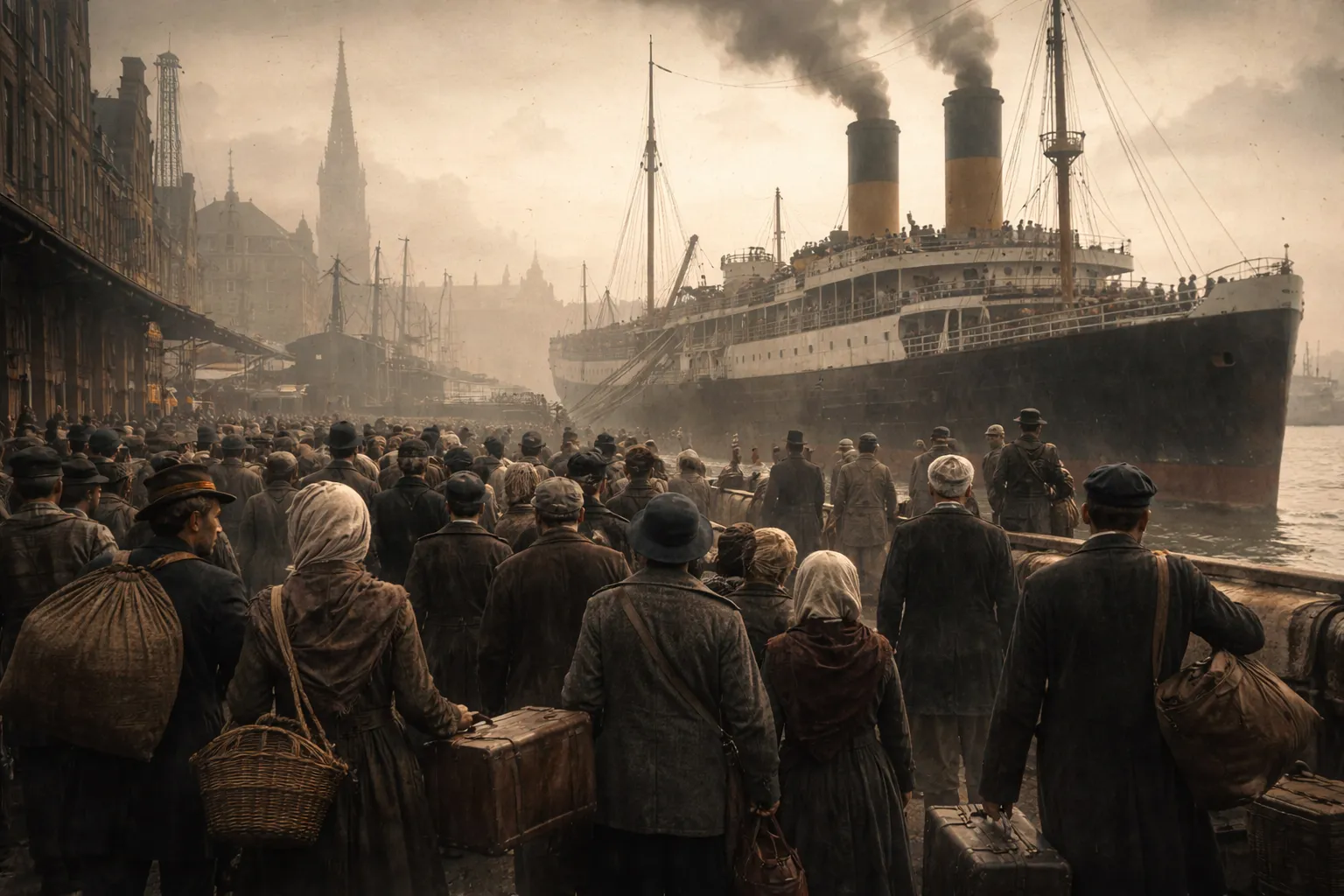
This is a guest article by my brother, a history student. He researched this topic for a university paper, and we thought it fit well here: a story about movement, systems, and people caught between institutions much larger than themselves.
Fleeing the Tsardom
In the late nineteenth century, political persecution in the Tsardom of Russia forced many Jewish families to flee their homes in Eastern Europe. Drawn by stories of opportunity “across the pond,” thousands set their sights on the United States.
For most, the journey led through Hamburg. The city was connected to eastern rail networks and had a modern harbor served by major shipping companies. One of the most prominent was HAPAG, which had recently expanded its fleet with large steamships capable of crossing from Hamburg to New York in under a week.
To recoup the heavy upfront investment in these vessels, HAPAG relied on the steady flow of immigrants, selling large numbers of steerage tickets.
Life Below Deck
Conditions in steerage were grim. Hygiene was poor, personal space was scarce, and basic comforts were reserved for passengers on the upper decks. With epidemics already sweeping parts of Europe, disease outbreaks aboard ships were almost inevitable.
As reports of illness reached New York, newspapers began warning of the danger posed by arriving steamships. Public pressure mounted, and the U.S. government responded by imposing a mandatory twenty-day quarantine on any vessel where passengers showed symptoms.
However, enforcement quickly revealed its bias. If no upper-class passengers were infected, ships were often cleared, despite the obvious risks posed by shared crew, contaminated food, and cramped steerage conditions. In reality, disease did not respect ticket class.
Media Panic and Political Pressure
American newspapers increasingly framed detained ships as threats brought by foreign, often explicitly Jewish, immigrants. Headlines warned of contagion arriving from Europe, while caricatures depicted Jews carrying cholera and typhoid to America’s gates.
Meanwhile, Hamburg authorities were forced to confront their own failures. After a visit from Robert Koch, the city admitted that sanitation had been neglected for too long. Cholera bacteria were even found in the Elbe. This only intensified the inflammatory coverage in papers like The New York Times and The New York Herald.
Immigrants were portrayed as the problem, while structural issues in sanitation and shipping practices went largely unexamined.
Caught Between Two Powers
For Orthodox Jewish migrants, the journey became a political tug-of-war between German shipping interests and U.S. public health policy. Quarantine periods were calibrated in ways that made transatlantic travel economically unfeasible for German steamships, while passengers remained confined in ship holds for weeks at a time.
They had fled pogroms in Russia only to find themselves trapped between two governments, stigmatized by the press, and subjected to harsh conditions in transit.
Conclusion
The passage to America was not merely long. It was dangerous, dehumanizing, and shaped by economic incentives, public fear, and political maneuvering.
Orthodox Jewish refugees escaped persecution at home only to be caught in an international dispute, confined below deck, and cast as carriers of disease. Their story is a reminder that migration has always been shaped as much by power and perception as by hope.